
From coastlines to plains, rivers to oilfields, America has always benefited from vast and diverse natural resources that have propelled our growth for generations. Each state and region has leveraged its unique geography and geology to deliver affordable, reliable energy to American consumers and businesses.
Today, that advantage matters more than ever. Electricity demand is rising rapidly, driven by AI and data centers, manufacturing and electrification. No single technology or fuel can meet this growth alone. An all-of-the-above strategy empowers states to capitalize on their natural strengths, reinforcing grid resilience, enhancing energy security, and supporting continued economic growth.
America’s National Energy Mix: Security Through Diversification
The U.S. Energy Mix Is All-Of-The-Above
Natural gas, nuclear, hydropower, wind, solar and emerging technologies each play distinct roles in supporting reliability, affordability and economic growth. Over time, the balance among these resources shift as conditions change and technological innovation advances. The shale revolution that began in the late 2000s, for example, dramatically expanded access to abundant, affordable natural gas, reshaping energy markets and bolstering US energy security.
Wind and solar generation also expanded significantly over the last 25 years, while nuclear has been a reliable, carbon-free baseload energy source for decades. While different resources are best suited to different regions, together they form a resilient national energy system
Rising Demand Requires Utilizing Every Electron
Electricity demand is projected to grow faster than at any point in decades. According to a recent ICF report,1 US electricity demand could grow up to 25% by 2030, and up to 78% by 2050. Meeting this growth will require regions to fully leverage their unique resources—both to meet local needs and to contribute to the broader energy supply. That includes not only fuels for electricity generation, but the entire energy supply chain, such as access to and development of American critical minerals that are essential to building and deploying energy infrastructure.
Regional Energy Mixes: States Leading with Their Natural Advantages
Regional diversity is already a reality: every single U.S. state relies on multiple sources for electricity generation (see Figures 1 and 2). Although some sources are more dominant in some states than others, no region depends exclusively on a single technology.
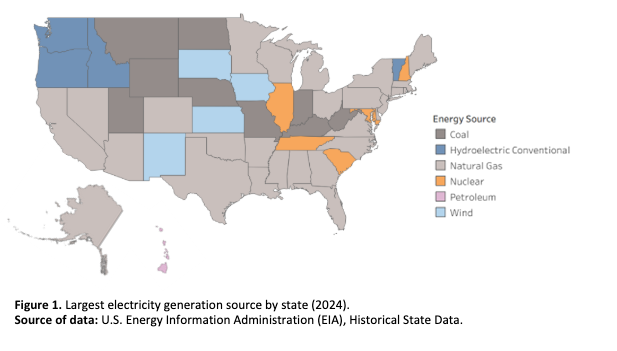
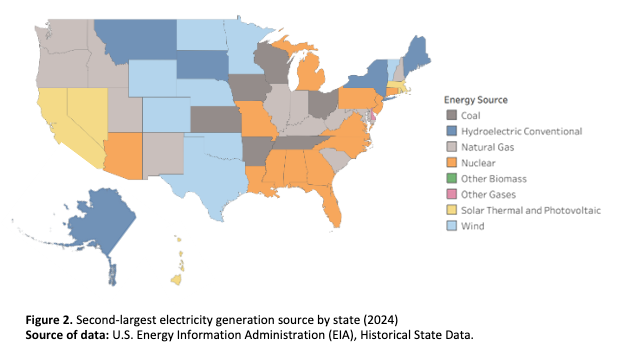
The American West and Southwest, for example, have high solar irradiance. Texas is a leader in both fossil and renewable energy generation—it is the largest producer of electricity from both natural gas and wind and is second in solar. States like Nevada, Colorado, Utah and Texas also have geothermal projects in various stages of development, reflecting growing interest in next-generation, firm clean power.
The Gulf Coast has abundant oil and gas resources, extensive pipeline networks, and large geologic storage formations, with a growing innovation ecosystem that is rapidly advancing carbon capture technologies.
In the Northwest, abundant water resources make hydropower a leading generation source. Washington, for example, leads the nation in hydropower generation, producing 25% of total U.S. hydroelectricity in 2024.
In addition to significant fossil resources, the Midwest has strong wind corridors and fertile agricultural land, making it a leading player in wind generation and biofuels production. In 2024, Iowa and South Dakota obtained the majority of their electricity from wind. In North Dakota, wind was the second-largest source of energy, and the state is also a leader in geologic CO2 storage, with eight Class VI wells currently permitted.2 Minnesota, in addition to possessing a diverse energy portfolio including fossil, wind, and nuclear resources, has enormous potential for domestic critical minerals development.
The Northeast enjoys coastal access and a dense transmission network. It relies on a mix of natural gas, hydropower, nuclear and renewables. In coastal states, there is significant opportunity to deploy innovative maritime technologies such as offshore wind or wave-powered projects. New York, for example, is a leading player in generation from natural gas, hydropower, nuclear, as well as offshore wind development.
The Southeast has abundant access to cooling water and a major nuclear fleet providing reliable baseload power, as well as natural gas and other fossil resources supporting flexibility. States like South Carolina, Georgia and Virginia anchor this regional strength through established nuclear infrastructure—with Georgia bringing recent experience in delivering new nuclear capacity. Virginia is also leveraging its coastal access and port infrastructure to explore emerging offshore energy opportunities.
Conclusion
American energy dominance is strongest when every region is empowered to develop the resources it has in abundance. By building on regional strengths and maintaining an all-of-the-above approach, the United States can meet rising demand, strengthen energy security, and ensure reliable, affordable power for decades to come.