
Wildfires are a growing challenge for communities, economies, and infrastructure across the United States. As fire seasons lengthen and fires become more intense and costly, utilities face increasing pressure to reduce ignition risk while maintaining reliability.
Advanced grid technologies offer a practical pathway to address these risks, reducing ignition risk, limiting damage, and improving response. Moreover, targeted policy actions—including reducing permitting delays, strengthening coordination, and maintaining federal financing tools—can help accelerate deployment and scale these benefits.
The Growing Wildfire Challenge
Wildfires have become more frequent, more intense, and more costly over the past four decades (Figure 1). As highlighted recently by the Department of the Interior, fires are “costing the U.S. hundreds of billions of dollars annually, damaging infrastructure, disrupting agriculture, driving up food prices and threatening lives and livelihoods.”i Longer fire seasons, increased development in high-risk areas, weather conditions and fuel accumulation have amplified economic and infrastructure impacts.
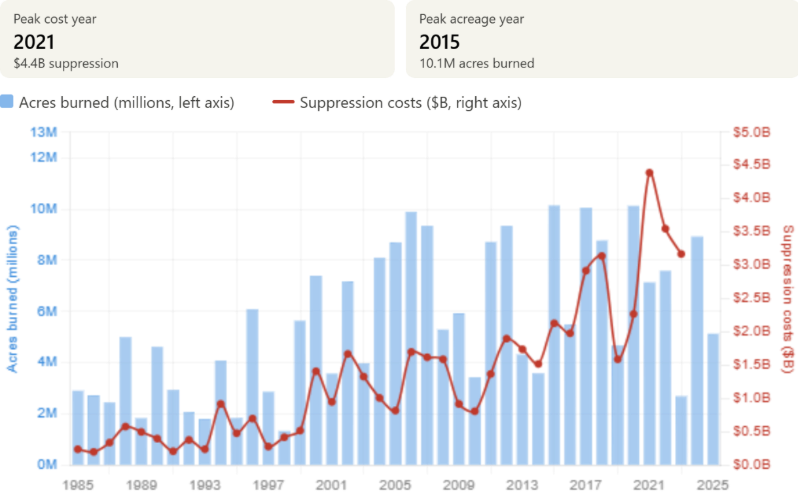
Figure 1. Federal wildfire suppression costs and acres burned, 1985–2025
Source of data: National Interagency Fire Center (NIFC), https://www.nifc.gov/fire-information/statistics/suppression-costs. Data reflects federal fiscal year totals for Forest Service and Department of the Interior combined, and includes suppression costs only. Suppression costs for 2024-2025 pending.
Even as suppression costs trend upwards, so do financial estimates of damages and economic loss. Estimates of the damage costs from the January 2025 California wildfires range from $95 billion to over $250 billion, far exceeding the estimated $30 billion cost of the 2018 Camp Fire.ii As wildfire risk expands geographically and seasonally, electric infrastructure operating in high-risk regions faces increasing operational and financial exposure.
Grid Infrastructure and Wildfire Risk: Ignition and Exposure Pathways
Electric infrastructure is designed to operate safely under normal conditions. However, in conditions of extreme wind, drought, and dry vegetation, events such as conductor damage, vegetation contact, or equipment and insulation failures can create ignition risk.
One particularly dangerous ignition pathway is electrical arcing—when electrical current jumps through the air between two conductors, or between a conductor and nearby grounded objects such as a tree branch. This arc produces an intensely hot discharge, which can reach temperatures of 35,000°F, exceeding the surface temperature of the sun.iii In low-humidity, high-wind conditions, even brief arc events can ignite dry fuels or expel burning debris, starting fires that spread rapidly.
At the same time, utilities face significant exposure from wildfires originating from non-utility sources. Transmission corridors, substations, and distribution networks are frequently damaged or destroyed by fires ignited by lightning or human activity. As wildfire intensity has increased, utilities have had to simultaneously reduce ignition risk and strengthen infrastructure resilience.
Technologies Reducing Wildfire Risk
A range of technologies can be deployed across the transmission and distribution grid to reduce both the likelihood and consequences of wildfire ignitions. While upfront investment costs can be significant, mitigation measures are substantially less costly than post-fire recovery and litigation. According to the U.S. Chamber of Commerce, every $1 invested in resilience and preparedness for disasters such as wildfires, hurricanes and droughts can save up to $13 in economic costs, damages, and cleanup.iv
The results of sustained grid hardening are measurable: PG&E, whose service territory comprises some of the most fire-prone areas of the country, reports that its investments in mitigation measures such as undergrounding lines, fault detection sensors, AI processing of wildfire camera data, and vegetation management have reduced wildfire risk from its equipment by over 90% since 2018.v
Hardening the Physical Grid:
- Covered conductors – reduce ignition risk by insulating distribution lines.
- Stronger poles – steel or composite poles that are less likely to fail in high winds or burn during wildfire events.
- Undergrounding – burying power lines underground. High cost but significantly reduces risk; best option in high-risk areas.
- Insulated cross arms – to reduce sparking risk during contact or failure.
Smart Protection Systems:
- Fault detection devices – sensors that identify abnormal current, arcing, or line damage in real time and signal protective equipment to respond.
- Fast trip settings – protective configurations that cause lines to shut off immediately when a fault is detected and, during high-risk conditions, disable automatic reclosing to reduce risk of ignition or equipment damage.
- Advanced reclosers – devices that interrupt power flow when abnormal conditions are detected, like outdoor circuit breakers, and automatically attempt to restore power after brief delay.
- Sectionalizing switches – automated devices that isolate a damaged section of a distribution line to avoid cutting power to a broader area.
Advanced Monitoring:
- Weather stations – local sensors that monitor wind, humidity, and temperature in real time. Standard practice in high-risk territories; can provide hyperlocal data to guide operational decisions.
- AI-driven predictive modeling – forecast wildfire risk based on weather, vegetation, and grid conditions.
- LiDAR vegetation scanning – laser-based scanning to identify vegetation encroachment and fuel loads (amount of dry vegetation) near power lines.
- Drones – UAVs can be deployed to identify damaged equipment of vegetation risks without the need for ground crews. Utilities such as PG&E are supporting the development of drone-enabled autonomous wildfire suppression.vi
- Wildfire camera networks – can be AI-assisted; detect smoke early so first responders can be alerted.
Microgrids & Resilience:
Microgrids are localized energy systems that combine distributed generation (solar, small natural gas generators, wind turbines, or other on-site resources) with energy storage and control systems.vii Their size, cost and complexity can vary, but they provide two key benefits:
- Reducing reliance on long, exposed distribution lines in rural, fire-prone areas.
- Enhancing resilience by keeping critical infrastructure such as hospitals, fire stations and emergency services energized.
Barriers and Policy Solutions
Permitting and Regulatory Delays:
Current Challenges: Many grid hardening and vegetation management activities require a federal permit when they occur on federal lands, even within established rights-of-way. This triggers environmental review requirements—sometimes under multiple statutes and across multiple agencies simultaneously—that can delay routine safety work by months or years.
As a result, projects that could be completed in weeks may face prolonged timelines, increasing costs and ratepayer burden. At a February 2026 House hearing,viii one rural electric cooperative in Arizona reported compliance costs for vegetation clearing and pole replacement along just 1.5 miles of line ascending to $500,000—a substantial capital burden for a small cooperative.ix These challenges are consequential for the over 90,000 miles of power lines that cross federal lands.x
Key recommendation: Expand and codify categorical exclusions to include for routine maintenance activities—such as vegetation clearing, hazard tree removal, and pole replacement—to ensure that routine safety investments are not subject to multi-year review processes, delaying the removal of identified hazards while risks compound. Codifying these exclusions in statute can give utilities the regulatory certainty needed to plan and schedule mitigation work ahead of peak fire season, as well as reduce ratepayer burden.
Federal Financing Tools for Wildfire Mitigation:
Current Challenges: Deploying wildfire mitigation technologies requires substantial capital investment. While utilities can finance investments through ratepayer cost recovery, federal financing tools can reduce costs, accelerate deployment, and support projects—particularly in rural areas served by cooperatives and small utilities—that may not have access to capital markets on favorable terms.
Key recommendation: Preserve and efficiently implement federal financing to accelerate deployment and reduce ratepayer burden through Programs such as DOE’s SPARK program (Speed to Power Through Accelerated Reconductoring and other Key Advanced Transmission Technology Upgrades). SPARK seeks to continue the mission of the Grid Resilience and Innovation Partnerships (GRIP) Program, which provided up to $10.5 billion in competitive funding over five years to states, tribes, electric utilities, and other eligible recipients to strengthen grid resilience and innovation. These programs can help meet rising electricity demand while reducing the share of mitigation costs borne by ratepayers.
Interagency Coordination:
Current Challenges:xi Wildfire management is fragmented across multiple federal agencies alongside state, local, and tribal partners. While coordination frameworks exist, overlapping jurisdictions and differing authorities can complicate coordination and slow decision-making. Differing rules, definitions and operational requirements across agencies can also hinder efficient project execution. Gaps in data sharing and system interoperability can also limit real-time situational awareness and coordinated action during high-risk conditions.
Key recommendation: Build on ongoing federal efforts, such as those outlined in the Trump administration’s Executive Order 14308, Empowering Commonsense Wildfire Prevention and Response of June 2025, to strengthen interagency coordination. Priority should be given to improving data sharing, operational interoperability, and coordination with state and local partners, including through shared approaches to risk assessment and planning to enhance prevention and response speed.
Conclusion
Wildfire risk is increasing, and advanced grid technologies offer a cost-effective pathway to dramatically reduce ignition risk and strengthen grid resilience. Moreover, investments in prevention are more cost-effective than post-fire recovery, particularly as wildfire impacts continue to grow.
Many of these technologies already exist, but deployment remains limited or uneven. Targeted policy solutions—including streamlined permitting, improved coordination, and effective financing—can also help enable faster, more consistent implementation while maintaining reliability and managing costs.