
Geothermal is a homegrown energy resource that aligns with core conservative energy principles: reliability, affordability and American innovation. As advanced geothermal technologies gain traction in the energy sector, it is worth recognizing the federal policies that helped get this innovative technology to this point.
For decades, Republicans in Congress championed policies to unleash geothermal resources by cutting red tape and accelerating innovation. As Congress considers the next chapter of geothermal policy, it is important to understand the history of policies that have impacted the development and deployment of geothermal. Below, we highlight the timeline of federal geothermal policy.
1970-2010: Catalyzing Geothermal Technology
While geothermal energy has been used throughout history, the U.S. government first began enacting legislation related to this resource in the 1970’s. The Geothermal Steam Act of 1970, which passed unanimously in the Senate, marked the federal government’s first significant commitment to geothermal energy. This legislation established a framework for leasing federal lands for geothermal exploration and development. Only a year following the 1973 Arab Oil Embargo, Congress passed the Geothermal Energy Research, Development, and Demonstration Act of 1974 with overwhelming support, delivering vital funding for research, development and demonstration (RD&D) projects.
Congress created the Investment Tax Credit (ITC) in 1978 and the Production Tax Credit (PTC) in 1992 to accelerate development, though technological hurdles limited expansion. The Energy Policy Act of 2005—introduced by Rep. Joe Barton (R-Texas) and Sen. Pete Domenici (R-N.M.)—and the Energy Improvement and Extension Act of 2008 reinforced and expanded existing incentives to support geothermal energy. Both laws received strong bipartisan support.
2010-Today: The Advent of Advanced Geothermal
In recent years, bipartisan support for domestic clean energy production resulted in significant policy achievements for geothermal energy. For instance, the Energy Act of 2020 advanced federal support for geothermal by establishing research and permitting coordination programs.
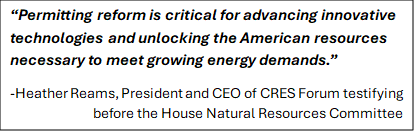
The bipartisan Infrastructure Investments and Jobs Act, passed in 2021, provided $84 million in new funding toward enhanced geothermal systems RD&D, reflecting growing consensus about the potential of geothermal to provide reliable, clean power while creating domestic jobs. America’s cumbersome permitting process remains a challenge, and a subject which CRES Forum has long been engaged. Congressional action to advance next-generation geothermal technologies must focus on removing these longstanding bureaucratic hurdles. Recognizing these obstacles, Republicans in the 118th Congress introduced several bills to advance geothermal energy and improve federal permitting processes.
The Lower Energy Costs Act, introduced by then-Majority Whip Steve Scalise (R-La), aimed to boost domestic energy production and enact sweeping permitting reform. For geothermal specifically, the bill had provisions which proposed to:
- Create parity between geothermal wells and oil and gas wells in federal permitting
- Expand the frequency of federal geothermal lease sales
- Exempt geothermal from being considered a “major federal action” under the National Environmental Policy Act (NEPA) in certain circumstances, which would expedite permitting timelines
While this bill did not become law, it signaled growing momentum to align geothermal policy with broader energy reforms. These recent policy milestones set the stage for the ambitious actions of the 119th Congress.
Geothermal Energy in the 119th Congress
In 2025, Republicans regained control of both the White House and Congress and the momentum for geothermal energy deployment continued to grow. On July 4, President Trump signed into law the One Big Beautiful Bill Act, which included key geothermal provisions such as preserving critical tax incentives, requiring annual geothermal lease sales on federal lands and enhancing the value of intangible drilling costs, among other changes to the tax code.
The Trump Administration also took a number of actions supporting geothermal energy. When President Trump declared a National Energy Emergency upon taking office, he included geothermal and declared it an “essential” energy source in a subsequent executive order. In February, Energy Secretary Chris Wright and Interior Secretary Doug Burgum both took action on geothermal in response to the President’s executive orders.
Republicans in Congress are continuing to seek opportunities to lower barriers to deploy the heat beneath our feet. Rep. Celeste Maloy (R-Utah) introduced the Geothermal Energy Opportunity (GEO) Act to establish firm federal deadlines for reviewing geothermal lease applications—highlighting the need for greater regulatory certainty. Rep. Young Kim (R-Calif.) recently introduced the Harnessing Energy At Thermal Sources (HEATS) Act to drastically streamline permitting of geothermal projects on non-federal lands. These bills are just two examples of the many pieces of legislation introduced by Congressional Republicans to lower barriers and accelerate the deployment of geothermal energy.
Federal Policy Actions to Accelerate Geothermal
Looking forward, Congress and the Administration should prioritize the reforms to maintain American leadership in the next generation of geothermal energy. In March, CRES Forum published The Conservative Case for the Next Generation Geothermal Energy, a white paper examining today’s geothermal technologies and makes the case for them as a truly conservative energy solution.
Below are some key recommendations:
- Remove obstacles to geothermal development, including modernizing NEPA, fixing permitting delays and adopting categorical exclusions for exploration and testing
- Targeted incentives toward geothermal energy as well as continued recognition in policy and legislation in the value of American resources
- Continued support for geothermal RD&D to accelerate access to the market
Congress and the Administration can build on the foundation laid by past Republican leadership. With smart, conservative policy, geothermal can transform its potential into real power.