
America’s electric grid is often called the “largest machine in the world,” spanning coast to coast and powering America’s homes, economy and our very way of life. Demand for electricity is growing at a rate not seen in decades, driven by the growth of artificial intelligence, domestic manufacturing and electrification. Coupled with this rapidly increasing demand, our current grid is also aging. Up to 70 percent of the nation’s transmission lines are over 25 years old with much of that capacity approaching their intended 50-80 year lifespan. America doesn’t just need more power generation and transmission capacity; we need it quickly.
One solution is “reconductoring,” the process of replacing conventional transmission lines with advanced conductors without the need for building new infrastructure. This comparatively fast and low-cost option can significantly expand the capacity and enhance the efficiency of existing of our existing grid. Accelerating reconductoring should be a priority to meet rising demand and help ensure electricity is affordable, reliable and clean.
Source: Proceedings of the National Academy of Sciences
What is Reconductoring?
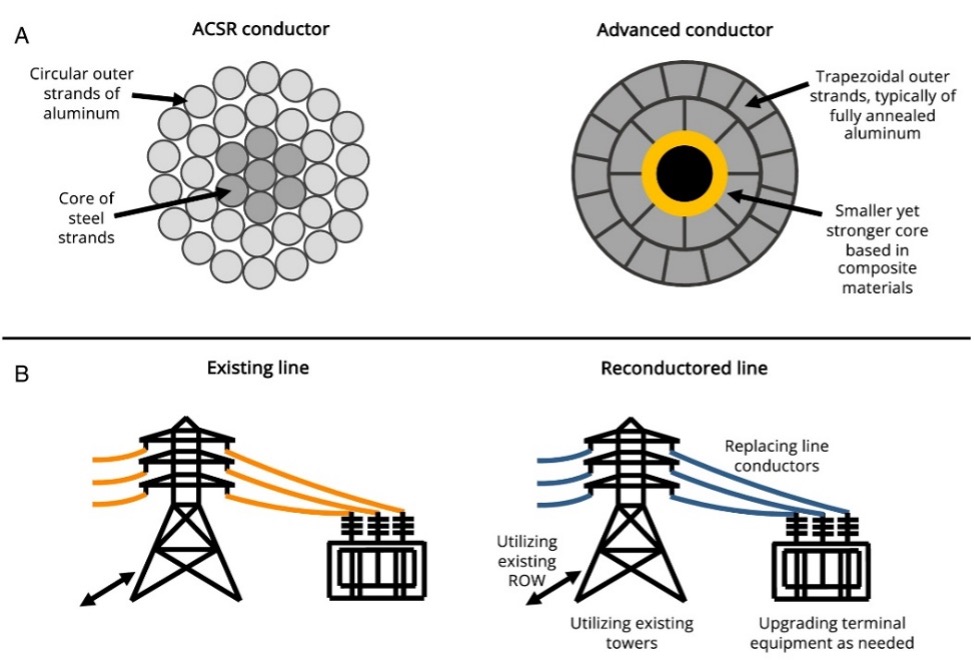
The majority of the U.S. grid is strung with Aluminum Conductor Steel Reinforced cables, a steel core wrapped in aluminum strands. This steel core expands when heated, causing lines to sag and limiting how much power can safely flow through them. Advanced conductors replace the steel core with lightweight, high-strength composites, such as a carbon fiber or a metal matrix. This allows for more aluminum in the same-sized cable, which means:
Double the capacity: Existing lines can carry twice as much power without replacing towers or expanding rights-of-way.
20-40% less energy loss: More efficient transmission means less wasted electricity.
Faster deployment: Upgrades can be completed in 1-3 years with minimal permitting, compared with 10 years to build a new transmission line.
The impact of these upgrades is significant at a time when the grid faces mounting pressure. As energy demand and new generation both surge, the grid’s transmission capacity is becoming a critical bottleneck. A 2025 study by Lawrence Berkeley National Laboratory found that approximately 10,000 projects, roughly equal to 2,300 gigawatts (GW) of electricity, are currently awaiting interconnection approval in the U.S. Advanced conductors act as a lane expansion for the grid.
This added capacity unplugs bottlenecks and allows energy to flow to the data centers and factories that need it most, both from existing sources and backlogged projects stuck in the planning phase. Finally, it provides grid operators with much-needed flexibility while rerouting energy during times of grid stress, creating a stronger and more resilient grid.
Challenges to Widespread Development
Despite its benefits, reconductoring remains underutilized. Despite costing roughly one-third as much as building a new transmission line, reconductoring projects have high upfront capital costs. Under existing federal permitting law, regulators may treat reconductoring as a significant upgrade, which might trigger a new round of environmental reviews. Ultimately, transmission providers may believe these factors provide more financial risk than other potential projects, so reconductoring is still not widely deployed.
Federal Policy Actions to Accelerate Reconductoring
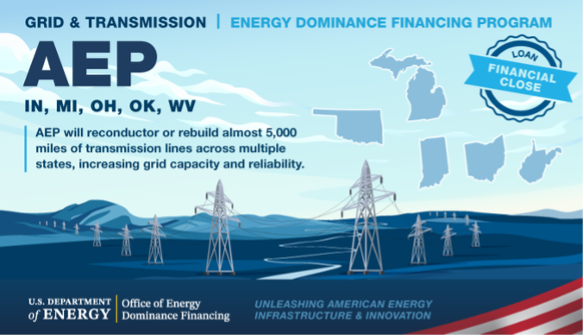
Federal policy is already accelerating the adoption of advanced conductors. For example, the DOE and American Electric Power (AEP) closed a $1.6 billion loan guarantee—the first ever made under the new Energy Dominance Financing Program. This loan will allow AEP to reconductor nearly 5,000 miles of line across five states, supporting local communities and the regional economy. This investment demonstrates the administration’s commitment to grid upgrades that enhance affordability, reliability, and energy security.
Source: DOE Office of Energy Dominance Financing
By reducing transmission losses and expanding capacity, reconductoring helps keep electricity costs down for American families and businesses. It clears the way for new energy projects to come online faster, powering the data centers and factories driving American competitiveness. And by strengthening grid resilience against outages and congestion, advanced conductors enhance our national security. With proven technology and growing federal support, reconductoring offers a fast, cost-effective path to a more reliable and affordable energy future.